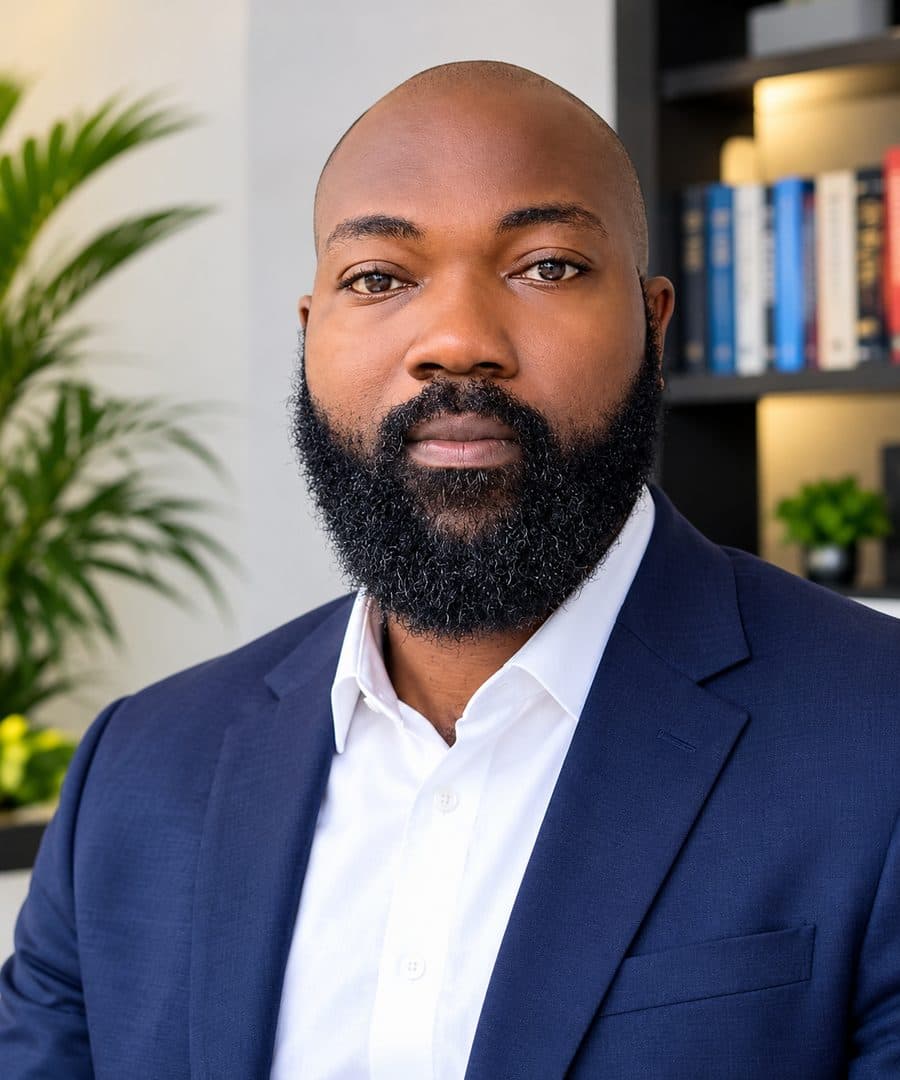
Ekene HillaryFounding ResearcherRead the full profile
A note from our founder
People are protected when help is close, clear and on time.
The lesson behind everything
For nearly two decades I have worked in technology, services and enterprise, and one lesson has followed me through all of it: people are protected when help is close, clear and on time. Everything I have built since, I have built to prove that.
Where it began
It began in 2008, right after my WAEC examinations, in my father's technical and engineering company: electrical and mechanical services, from the sales, servicing and maintenance of large generator plants down to small generators. It was a people-centred business, and it taught me what no classroom had. A service is only as good as the way the person on the receiving end feels when you leave. It also taught me a rule of machines that I would later find true of people: what is maintained rarely fails, and what is neglected fails at the worst possible moment.
Then I spent a couple of years with the Lagos State Ministry of Women Affairs (WAPA), learning technical skills in refrigeration and air-conditioning, known globally as HVAC. By 2013, something deeper was pulling at me: a strong desire to work for the development of the younger generation, especially young people on campuses. So I started iCity Digital, with Campus Tech Talk Africa as its campus-focused arm for development and social impact, both built on human-centred design for development and technology services. Designing with people, not just for them, became my method. In 2020, that method was tested.
When it became real
COVID-19 made it harder to reach a doctor at the moment people needed one most. In Owerri I worked on building Uloogwu Health, a web-based digital health application, and as a community health advocate I built the system and strategy behind it, so a patient could find the nearest doctor, laboratory or clinic and book an appointment ahead of time. Alongside it, I promoted prevention and awareness in line with the public health requirements of the time. That is where I learned what prevention can do: the best moment to protect a person is before the crisis.
Widening the circle
I carried the same thinking into the community, through social clean-ups, sanitation drives and other environmental activities guided by ESG principles. Health does not stop at the clinic door: people, place and planet are one system. And of all the people that system touches, one group kept pulling me back.
Why our children
One pain point never left me: how we protect adolescents from drug abuse. Adolescence is when habits, friendships and beliefs are formed, often faster than parents and schools can follow, and too often we act only after a child is already in trouble. At first it was only a question. Then it became something I could picture, a different way of doing prevention, and it stayed with me into the start of my M.Sc. at FUTO.
How it became ALTDAP
I took the idea to our department's research coordinator. After a short conversation, it was settled: this would be my M.Sc. research in Sustainable Social Development.
In 2024, I began by studying what was already on the ground: how drug abuse awareness and prevention among adolescents are usually done, what those approaches had achieved, and how to improve the process so that it delivers better results and lasts.
The work needed a name. It started as “Alternative Drug Abuse Awareness”. As the research reached its audience, we saw we were working with one clear group, adolescents, and the name sharpened with it. Guided by my supervisors, Dr. Emmanuel Amadi and Dr. Sylvia Egbom, who helped give the research its scope, it became ALTDAP: Adolescent-Led Technology for Drug Abuse Prevention.
Then we tested it. In our first pre-test and post-test sessions, participants answered the same questions before and after the training, so we could see what changed instead of assuming it. Those sessions turned ALTDAP from an idea into evidence.
When I began my PhD, I took the M.Sc. results back to more people in the same audience. What we saw widened the aim to include sustainability: prevention that lasts a lifetime. ALTDAP now stands for Adolescent and Lifelong Technology for Drug Abuse Prevention. The name is still the method: adolescents at the centre, technology as the carrier, prevention as the aim, and lifelong as the goal that makes it last.
My research has been accepted by IEEE NIGERCON 2026, and I now deepen it as a PhD researcher at FUTO.
What we do
ALTDAP is an awareness infrastructure. It gives families, schools and organisations research-based, technology-enabled tools: games, short courses, live LaunchPads, a family guide, and a WhatsApp companion for instant help. Through training, guidance sessions, focus group discussions and community events, we have reached more than 1,000 people. We teach more than the risks of drugs. We build confidence, vision, communication, digital skills and employability, because a young person with direction and self-worth has more to stand on.
What we are not
Our work is awareness, prevention, analysis and education. It is not treatment, and we point families who need treatment to licensed professionals. In an emergency, we send you to the nearest hospital or clinic first.
Why I keep going
My faith shapes how I work: with care, dignity and responsibility. My own growth has been deliberate, through study, training and service, and I want the young people we serve to have a road like that, opened earlier. I recently joined a radio conversation, “Prevention Begins at Home: Raising Children Equipped to Make Better Decisions About Drug Abuse”, because I believe it.
Your first step
Prevention begins at home, and it can begin in yours this week. See the ALTDAP Family Plan, watch for our upcoming live trainings, or write to us directly.